Saturday, November 19, 2005

Samurai William by Giles Milton


An Engaging Account of an Incredible Period
Samurai William by Giles Milton

This book is a work of non-fiction which has points and events which one might imagine would be settings and scenes for a movie.

But this is all based on historical accounts, curried together from a wide variety of sources; the research of this book is astounding. Milton has scavenged many original and reprinted log books from period voyages in the languages of their lands, and the personal diaries of most of the principle characters. His first-person characterizations of the all too human leaders of English commercial enterprise in Japan are the real treasury of their efforts, as is well worth knowing, the East India's first foray into Japan was a commercial failure.

William Adams is the most notable character; he is the "Samurai William" of the title. Shipwrecked in Japan in the early 1600's as a sailor on board a Dutch trading vessel. His early story is of a man who survived ordeals and eventually mastered the local language and customs, rising to favor under a partial Shogun and given a title, lands, and authority unprecedented in Japanese history.

While he played Jesuit, Portuguese, and Dutch interests off each other in the beginning of his decades of influence in Japanese foreign trade policy, Adams became gentrified in only a manner which can be described as resultant of the good influence of his environmental conditions. He was of little consequence in England, having been from Limehouse, but in Japan he literally had the ear of the Emperor.

It seems implausible to some, but the worst thing that happened to Adams was that he was rediscovered by his countrymen. The English sought Adams out, and hoped to profit from his experience. However, imperialists can be at the best graceless and at the worst dangerously petty; the first encounter of Adams was less positive than expected.

Perhaps he was perceived to be shipwrecked and marooned in a far off land without any resource, recourse or influence. Perhaps the English expected him to be grateful that they came looking for him. For his reserve in availing himself to the English first arrivals he was considered haughty and suspicious.

So his overall aide to English interests was to solidify their trading position in Japanese courts time and time again; especially when the local factors disgraced themselves either through debauchery, wantoness, or improprietry.

Adams witnesses the Jesuit growth in Nagasaki, subsequent rebellions, massacres and repressions due to power plays and failed uprisings of Christians. As well, the trade in silk and sappan wood with Southeast Asia, namely the ports of Bantam, and Pattani are fascinating journeys into the sea routes and English designs of the period.

The Dutch, the Portuguese, and the Spanish fleets also sail to and fro through the backdrop to fuse the realism and ongoing interplays of war, factionalism, corruption, intrigue, and peace which plagued British fortunes in Japan.

A reader of Samurai William enjoys the thrill of first-hand accounts, and Milton has built a masterpiece of drama, narration, period setting, and interconnectiveness that gives real significance to the characters and lives of Japan's earliest European traders.

A Soldier's Story

To Understand Bradley, One Must Understand Patton

To Understand Bradley, One Must Understand Patton
Review of: "A Soldier's Story"
Omar N. Bradley (1951)

This review of "A Soldier's Story" by General Omar E. Bradley is being written following a thorough reading of the Modern Libraries Edition, with an introduction by Caleb Carr, who is worth noting as he explains completely the motivations of readers of military history with, "they are often among the most committed and well read people one might hope to encounter." Self-servingly, I could not agree more! Furthermore, he establishes the logical link between military history and social or political history with, "those who know...cannot understand war without understanding its political and social underpinnings." and vice versa. Bully! This would explain my father's own rather complete library on the topic. And the reading? Look, we lived in the country, a free country, with long cold winters, books are a common companion in such places. Especially when it is too cold to go outside. Or in my case, too hot!

First of all, successful outcomes in war are determined solely by the wisdom of its leaders in the battlefield, the Generals themselves must in some way define the purpose of fighting, which in of itself is not a logical exercise, there is no logic in willingly putting oneself in the line of fire. Von Clausewitz emphasizes this. The purpose usually appears to be defined by a threat to home, country, and often is an attempt to protect the weak or oppressed. However, war begins in the causes of greed as my own prelude suggests, O.K. it looks like a brick bat but it is based on the facts. I do not take Caleb Carr lightly, I have attempted to diffuse some of my reading in relationship to General Bradley's story, which he claims is wholely opinion, by tracking through a few related texts, namely, "The Art of War" by Sun Tzu, an unofficial but highly acclaimed biography of General Patton by Carlo D'Este entitled, "A Genius for War", as well as readings from other translated Chinese military texts, and associated heavy-heavy readings in cross-cultural competencies courtesy of Charles Hampden-Turner and Fons Trompenaars, and birds like them, experts in the field of cross-cultural management issues. It is useful to attempt to gauge intrinsic competencies in a reading of General Bradley. Much of it was a real pleasure. Writing about it soldifies the learning experience and shares it.

Bradley was a second tier candidate for entry into West Point in 1911, contrasted to Eisenhower's first rung placement, and while they were writing exams in the same room, and graduated in the same class, Bradley was more clearly a soldier's general because of his middle class and religious upbringing. He was extemely temperate in all affairs, taking his first drink only in his early thirties, and trained as an infantryman. He found himself reassigned at the approval of Marshall out of a list of candidates submitted by Eisenhower.

He was entering the Operation TORCH Campaign in Tunisia in 1943 following Eisenhower to the front to become his eyes and ears in a battlefield that had suddenly caused SHAEF in the UK, (Supreme Headquarters -Combined Allied Military Management- American English Forces), and US Chiefs in Washington to question US battle readiness. US entry to the Second World War was delayed nearly three years into the event, Roosevelt, long sympathetic to UK efforts, had been providing Churchill and his armies with production, battleships, and weaponry through the lend-lease aggreement, but was finally given a mandate by the American public due to the Japanese attack on Pearl Harbour. Churchill pushed for immediate attack, it was clear from the beginning that the US was by far the larger contributing force, but really, who was paying the bills? It took more than two years to ramp it all up.

When the attacks around Tunis began, all went well, but counterattacks into General Fredendall's sectors provided General Von Arnim with a strategic victory. Heading west into a line of north-south hills, German tiger tanks were able to pierce American infantry defenses loosely clumped in jebels throughout the area, high sandy mounds easily surrounded, surmounted and eliminated. Fredendall was cosily rolled up in a ball in a rearguard bunker.

It was known as the Battle for Kasserine Pass, and Bradley realised quickly that the losses could have been prevented. The issues of the defeat implicated a global image of US military effectiveness, horrible for morale and public reports mostly led by the BBC quickly concluded that the US Forces were immensely inferior to British ones, often and mostly led by General Sir Harold Rupert L.G. Alexander and fronted by General Sir Bernard Law Montgomery. This was an image extremely hard to shake, it can also cause the failure of product launches in business. This was a cross-cultural issue of supreme importance on the battlefield, as the US and UK forces shared wide fronts and flanks despite insurmountable differences in standard materiel and hierarchical leadership methods.

Bradley revealed causes for failure were mostly in a preponderant lack of US field trained officers. Hence easy explanation of the difficulties with which Bradley, Eisenhower, Montgomery, SHAEF in general, and perhaps most western, liberal-minded media writers and readers responded, often to their own detriment, to the methods and public outbursts of one of the Allies' only hardened field generals. Of course, his name was General George Smith Patton.

By even his official biographer's accounts, Patton was quite insane. He suffered from delusional spells supposed due to severe falls from horses over many decades, due to and impacting upon his audacity, and faith in the belief that he was a reincarated embodiment of many historical leaders. He also relied heavily upon divine providence. His was perhaps one of the last of a long line of aristocratic officer-class candidates to serve in the US military beginning his studies at VM1 and West Point in 1911. His methods were often perceived as brutal, but he was a cavalry officer who easily made a transition to expertly manage tanks and mechanized cavalry during the First World War and having served under Pershing, was early made famous for his exploits during the Mexican civil wars and in the hunt for the renegade Pancho Villa as early as 1916. He was a soldier motivator of the Joseph Juran School of Quality Management as fear, outrage, and insult were his prime people leadership motivators, especially in the eyes of his critics. Something which never comes out in this story is how completely Bradley detested his methods. But I think this just reveals humaneness.

Bradley had his reasons. He had served under Patton during the Sicily Campaign. If anything, their disputes were theoretical. Bradley believed that to spare his men, he must cautiously and closely manage their offensives, and take decidely defensive positions during offensive actions. Slow progress. Patton was the polar perspective, to spare men, he believed one must be as offensive, and as decisive, driven, and outright into the battle as possible. Blood-thirsty. His nickname was "Old Blood and Guts". Their powerful divergences on these two necessary motivations for fighting war and their relationship to the welfare of their soldiers were almost black and white, and cause for each to mostly succeed, but at times dismally fail. But their challenges to cooperate were also the result of other factors.

The pressures under which leading generals of the US Forces were dealing with were manifold. First, concentrations of field-blooded officers and leaders in the outset were terribly low when compared with bunker-couched theoretical experts, there were bevies of treacherous, over-political, over-supported overseers in non-combative departments such as communciations, intelligence, logistics, supply, public relations, all internally in various states of readiness or complacency to assist with the management of battle field necessities. The War-Machine experience to this date was built from and for stalemate trench warfare experiences. Thus as ever, a great deal of actual decision making was made far from the fronts, political, intellectual, and media-driven debates often protracted the chosen conflicts and micro-managment tactics often removed senior commanders from positions prior to being given opportunities to prove capable of quick adaptions. In contrast to British Forces, US Forces too quickly removed poorly performing, basically green senior commanders from the field, while the British were again polarly over-generous and left the wrong leaders in command far beyond the proofs of their field incompetence.

These types of contrasts wonderfully illustrate cross-cultural issues relating to theories of intercultural variations and merits and flaws in the areas of individualism and communitarism, or the ability to freely make independent decisions or question direct commands as British officers were more highly likely to do, versus universalism and particularism, where the US Forces often appeared more likely to accept questioning of orders and diversion from established plans when coming from Montgomery and his forces rather than from Third Army, or specifically, Patton. War highly defines these cultural divisions, seemingly, like no other exploit. Following the eventual defeat of Rommel's armies in North Africa in 1943, the issue of Bradley as a moderating middle ground leader among SHAEF's Allied choices became clear in Sicily.

The initial battles for Italy took place first in Sicily and amphibious landings and the competitive or cooperative forces which make or break generals. In this invasion by sea, Bradley was stuck between Patton and Montgomery and Alexander, the US Forces were in part forced to backtrack to the beaches of Gela and Scoglitti in costly times of delay, to permit the British to cross their right flanks along the west-east road of Vizzini in their attempt to surround Catania from the west rather than barrel straight north through Catania to their target of Messina. It was treacherous territory, well defended mountain ranges and passes, the Germans were given ample time to prepare for British attacks.

Meanwhile, Patton was assigned the less challenging western approaches to Palermo which he proved quick to capture. However, the British became bogged down, and Patton's desire to attack from the northern west to east routes was loaded on Bradley, with several less than satisfying leapfrogging amphibious landings along the coast in an attempt to catch German forces in their rear flanks. The tactic never really succeeded. But with Patton plowing along behind, eventually US and British Forces met in Messina. Their arrival might have been earlier had the British stuck to the eastern routes from the very early days of landing, and Bradley might have been better used carrying defensive offense along the middle, heavily defended mountains.

However, Bradley came out of Sicily, Patton did not. Patton had been pushing everyone's limits, that was his method to achieve victory, and incidentally slapped some shell-shocked soldiers in an army hospital. The media and his image went nuts. He was then left on the island, even though he was considered by the Germans to be their most fearsome adversary. Men like Patton simply do not usually succeed in western countries? However he was quite a pet of Marshall and Roosevelt. But furthermore, Bradley was found to be, conversely, a dutiful officer, one who routinely followed orders, the same could not be said for either Patton or Montgomery, whose excuse was often, in the case of orders he did not agree with, to simply ignore them. Incidentally such tactics always seemed to work for British Imperialists. Bradley demonstrates how authority appreciates subservience, and in the military, well, is there any other kind of service so highly based upon the following of and fulfillment, or rewards based thereon, of orders? It looks like Bradley may have realised he walked into his job because Geronimo went Humpty-Dumpty.

In the intervening months of 1943-1944, Italy was over-run and the complete scale preparation for the largest seaborne amphibious multi-force assault in history was underway. Bradley proves his even balanced assessment abilities in noting clearly the stake and possibility for defeat in D-Day. First, he credits the Allied misinformation tactics regarding most likely landing zones. Successfully, the Allies convinced German intelligence to believe that their attacks would take place upon the nearest shores, in the areas of the channel near Calais. As Patton was their most feared adversary, his location was cloaked, as he was believed the leader of the assault. On the day of the invasion itself, June 6, 1944, the landings in Normandy near Caen were believed to be diversionary, which proved German flaws in estimating a landing location and Allied strengths. One could possibly submit that the same fatal flaw, namely an Army micro-managed by an insane Hitler, could never hit strategic planning projections of any great value. There is even a slim possibility that German intelligence would have preferred easy Allied victories in the west to Russian advances in the east. In such strategic cases, Hitler's insanity and megalomania, strangely enough, appears an ally. Churchill made much of such pricks upon his hide anyway.

Bradley's observations illustrate the tenuous conditions implicating success or failure, where success may simply come less from personal credit other than firm will and decisiveness, as Sun Tzu posits, rather more out of the failures in deductions and assumptions made by one's enemy. For each adversary, this was the case and defining victory or defeat repeated over and over. A candid accounting of vulnerability, reveals the benefits of another man's lack of initiative. The absence of Goring's airforces on two occasions, one being D-Day, the absence of chemical attacks or bombings, either on continental D-Day bridgeheads, or their equally mystifying absence of offensives on the evacuation beaches of Dunkirk in 1940 also reveal.

Such events sealed significant early German defeats. One can extrapolate such failures in offensives to the business world, and current US strategies in exiting market segments which do not offer minimum rates of acceptable returns to international competitors who often accept rates of zero or negative returns simply to guarantee successful entry. There is a shadow of US industry in such an extrapolation and in particular the current bleeding GMC giant which Bradley easily foreshadows.

What follows is Bradley's opinions on the relentless, often slow push eastward into the rest of Europe which ground down and cost many lives, often ill-reflected and not well distributed, often the same rifle companies continuously exceeding 70 and 80% loss rates. What slowed progress was not always the fighting will of the enemy. Just as culpable were the agonizing delays in offensives caused by materiel supply, human replacement rates and redistributions, and supply inabilities to properly serve proportionally equitable allotments of ammunition and fuel.

Necessarily, the supply lines were vast undertakings, but Bradley felt the airforce and navy were often to fault for failing to quickly and carefully coordinate with ground forces in major offenses, no surprise coming from an infantryman. Issues of friendly fire early strained relationships with bomber command, and Patton rightfully complained that Montgomery's forays, such as the attempt to rout the Seigfreid Line via Arnhem and PROJECT MARKETGARDEN came at expenses in cavalry blitzkrieg territory gains. Effectively, Patton was to distinguish himself mostly by employing the same methods of attack and quick envelopment of the enemy's rear flanks as those the Germans employed against the Polish as early as 1939. Of all armies, The Third was most successful in the coordination of air support for fast striking attacks using mechanised cavalry.

So however effective Bradley was in analysis, he often failed himself to quickly adapt to events, as in the case of the Falaise Gap, through which he did not pressure SHAEF to encourage Montgomery to close the gap from the north, something a British General probably would have pushed harder for. This allowed fleeing Germans in the thousands to escape France across to Germany. His argument against is weak, considering the success of the Rhur Pocket Crab Claw. In some ways, his established commonness is also reflected in his wide, slow front perspectives, mirrored by his actual wide slow fronts, this commonness was supposedly endearing to the vast majority of his men, but Carlo D'Este quotes an informant that being in someway average, or perceived to be so, may have been merely an easy way for the "Soldier's General" to simply disappear from the minds of his subordinates.

Considering the more wild antics of both Montgomery and Patton, on the people-management front, and on the actual fronts, Bradley is a considerable comfort. Of course he held such lines with the likes of General Hodges, who seemed quite divided, and actually became divided temporarily under Montgomery during the Ardennes Offensive which caused many ruffled feathers and an adamant warning from General Bradley that he would quit if ever placed under British Command again. More than common feathers were ruffled in the event. Patton was prepared for it while Bradley was not.

The Ardennes Offensive highlighted the differences between common sense and strategic sense among the Allied war leaders. Bradley realized in hindsight his flaw in allowing such a weakness to exist in the line under his command. It was all a result of poor organisational intelligence, in fact, the same point through which the Germans had routed the Maginot Line during their invasion of France. It was here located the greenest of US units, and a rest area for front-liners. At this time, Bradley made the same mistaken assumption the Germans had made on D-Day. He thought the Ardennes were a diversion from a possible counter-attack north of Aachen and the Roer Dams. However ignored was Patton, he had anticipated something similar which pointed to his genius.

Patton had assembled his staff, and entrusted with them, something the finest leaders rarely do, a selection of three possible battle plans, to be executed in his absence although to be engaged and completed within 48 hours following a telephone call from his meeting with Bradley, Montgomery and Eisenhower. Initially, Patton demonstrated the kind of flexibility and faith in his command most Generals rarely possess, and an actual trust in the command decisions of his subordinates, which translated, almost essentially, vertically straight down to his enlisted soldiers. It was logistically nearly an impossible event. Following a telephone call in the early morning, he had instructed his entire army, in excess of 133,000 tanks and trucks, guns and equipment on a trek 50 to 75 miles over an icy secondary road to relieve Bradley's right flank and rescue elements of encircled Twelfth Army Group in Bastogne.

In itself, Patton did not win the Battle in the Ardennes. But he demonstrated that split decisions are often based on quick assessments, and require nearly impossible efficency to be successful. But on the rarest of occasions, the results are absolute success. Patton ensured his unsurpassed place in military history for the event. This would exemplify the W. Edwards Deming School of People Management.

Bradley does not overly examine Patton's exploits in the Ardennes. However he appeared to appreciate Patton's talents a little more, especially as exemplified by his new-found negotiation skills regarding the bridging of the Rhine. As usual, Montgomery favoured a single offensive, led by Montgomery. Patton was eager to forge ahead of even his own supply lines, in many cases pilfering German stores even though the grades of gasoline differed and soon fouled his Shermans, and Bradley as always with Hodges, appeared to be carrying the middle.

Patton opted for a pincer or crab claw, particulary to prove useful in the Rhur Pocket. Montgomery finally caved and much credit comes to Bradley for insuring that Patton was not sidelined from efficient territorial gains south of pre-planned locations as in the Remagen Bridge crossing. Elements of both British and US command were displaying management by objectives myopia regarding the crab claw idea. Considering the German efficency in demolishing Rhine bridges, Patton was demonstrating again the benefits of fast attack. The bridge was fully wired and it is only an example of how fast Third Army could move that it was not blown up. Without Bradley's listening to Patton's ideas on what to do with the bridge, all of the supplies for the assault would have gone over to Montgomery. There would have been no claw, there would have been a cull, and thousands of more lives would probably have been lost. Bradley was beginning to acquire and snap with demonstrated flexibility.

It is here that I think the war was mostly won, mostly because Bradley had become more like his British competition for the ear of Eisenhower, and despite his misgivings, he became a closer ally to Patton. Synergy began to display itself when the claw was put into effect. It was the right choice and trapped several divisions of Germany's remaining battle hardened forces. The following chapters tie up the loose ends regarding divisional areas and linking up with the Russians in partioning of Germany, something Bradley notes almost looked like a continuation of war with the Russians.

For Bradley to be read singularly, one would miss the diverse views and opinions. But essentially his is an honest appraisal, and a worthy read of the opportunities and pitfalls in the waging of war. Bradley does not gloss over the horrors. But he polishes the insights and disciplines displayed by Allied Commanders which did the best they could from the perspectives each man came with. I believe Bradley in fact was able to critically examine and understand his role as a leader more humanely than Eisenhower. This book is a credit to history and what it teaches careful readers.

This is the smallest, simplest abbreviated little souveier I could make of it.

Friday, November 18, 2005

A Review: Embracing Defeat: Japan in the Wake of World War II


Embracing Defeat: Japan in the Wake of World War II
Dower, John W.

This book is highly recommended not only due to its numerous awards and accolades, but because Dower reveals the merit of competent research which always provides enough evidence for glimpses of the overall issues, and disparate viewpoints. His own conclusions on the matters of Japanese economic, social, and political reforms following Japanese unconditional surrender are very interesting.

There are few parallels to the Japanese surrender in contemporary history. Perhaps the analysis offers insights into the current situations faced in more dramatically regionalized and fractionalized post-Gulf War Iraq for example. Dower illustrates the uniqueness of the victor's position and that of the vanquished.

The opening sequences of "Embracing Defeat" put a human face upon the tragedy of Japan's wartime exploits. A useful reading of Modern Library Chronicles #11: Inventing Japan: 1853-1964 by Ian Buruma previews and reviews the finely detailed traumas inflicted on Japanese society as a result of the military micro-management of all aspects of society prior to and during the expansion of the economic sphere of Japanese imperialism. An expansion that by Dower's account left few responsible or accountable following surrender.

By confirmation and interesting note, Ian Clark notes in "Globalisation and Fragmentation" that Japanese influence filled a void which the British left following WW One.

This book readily reveals the intricacies and challenges in any attempt to reform, reshape, and rebuild a society from pulverized military destruction. However the paradoxes also mount and build, complex interconnections remain, especially in the legacy of democratization and reforms courtesy of SCAP and Macarthur.

That these heavy-handed and autocratic methods largely succeeded as basis for reform are credited to the largely militarist nature of Japanese political hierarchy at that time, and a dubious selectivity on the part of US occupation administration, namely, the exoneration of the Emperor from blame, public reprimand, reprobation, or censure.

Perhaps as symbolism he could be no more useful a significator of progress, as his salvation came about, because so many were willing to shift blame and responsibility to others for more productive incoherency of legacy, purpose, and potential gain. It seems all parties profited from the survival of the monarchy as a figural martinet.

It was also clear from the start that representational justice was not an issue. The show trials and executions were performed with very little hope for defensive manuevers. So too, little representation among the judges could be revealed among citizens of occupied nations. But since the trials were not really about justice, but retributions, there should be little complaint. Unfortunately the complaint appears to be that figureheads were removed, mottos were changed, but the old guards, and many old ways remained in place.

New information to this reader, and startlingly brutal, is the food rationing and smuggling which ensued under American occupation during the early years of the occupation. It seems the profiteers were often the same industrialists and entrepreneurs who managed to squirrel nearly the entire commodities base of a military, highly engineered, highly organized economy into the black-markets, either under the noses of, or with the complete complicity of American occupiers.

I am never quite convinced of Dower's stand on this issue. But it smells much like "Oil for Food" in some way, even similarly as some leopards may rarely change their spots, another "Smaller Emperor" remains standing in the present at the UN.

The feminisation of Japanese culture by a conquering and overbearing American occupation force is particulary evident in this historical documentation of the evidence. It is sadly repeated many times over by conquering forces and the Japanese themselves are no strangers to a legacy of making servility a prime focus of domination in their wartime exploits.

However Dower correctly implicates many of the results of American influences in the undercurrent of rebelliousness and its influence, or lack thereof, in democratic reform. While at one hand, the same ideological principles used to support Japanese expansionism were then subverted to the causes of occupation led democratic social reform, so too the blackmarkets, sex and literary subcultures of katsutori reveal their parts in the scene and setting changes of concrete social change.

So too the immense and extensive controls upon media, public debate, demonstration, union, and communist forces by the US and Macarthur also played a significant role in the artistic or silent protest of totalitarianism and the authoritarian nature of occupation ideals.

It cannot be disputed that the US reforms were designed and led from a perspective of superiority whether economic, social, cultural and political. This was not the first democratization process influenced by the US or with such a perspective of Asian inferiority. However it is enlightening to note how well Dower notes the absence of Japanese experts from the decision making process either in the US or in Japan.

So much of the process was dictated by men and scholars with heavy agendas and no real understanding of the local people on the ground. So it is quite amazing that any good can be attributed to the occupation process in terms of cultural reprogramming. Even if that was a stated goal, the support for the conservative, thus formerly militaristic elements of Japanese society certainly appears a stronger note of question.

The underestimation of Japanese industrial and economic capacities are noted well, especially as Macarthur's own stance, that Japanese society was akin to a "twelve year old boy" while German and European societies were far more aged. But there are other studies which prove that Taylorism was well implemented even prior to WW one, that scientific methods and industrial capacities were highly evolved, and extremely efficent, particularly in the military industries. Japanese quality and processes in the export trade markets were early sacrificed to military production.

In this area, Dower could have provided much more rich detail, in particular, his review of Joseph Dodge and Bell Laboratories personnel such as Deming could have been more illuminated to distinguish how far from fact was general US perspective on Japanese productivity and potential for export growth.

Certainly the section on democracies was most interesting to me, mostly because the underpinnings of the Japanese constitution are so completely foreign to Japan. Dower makes the outstanding conclusion that the overall effects of US occupation created a stylized Japanese culture of self-censorship. He posits that those aspects of Japanese culture most associated with the Japanese as norms and values of their particular culture might more easily be originated to US democratic designs and restrictions in the early stages of Japanese occupation democratics. It remains to be seen how the Iraqi constitutional debate will play out, but it appears far too clear that the same rationale has been applied.

All of which culminates in a peek at Japanese society which, for many reasons, continues to appear oblivious to its causes and effects in inter-Asian history, continues to mourn its own losses more highly than its victims, remains ideologically isolated, and appears ponderous on the road to continued economic development. Dower makes a great case to examine the overall notion of victor-inspired reforms and loser-inspired concessions.

His case on Japan is truly worth reading as it really sheds light in many directions and appears to reveal much more than it obscures. It is a history which takes its relevance from ongoing and fascinating reconstruction efforts globally. Too bad he so readily blasts cross-cultural studies and the precepts of Kluckhohn, Hofstede, and the MBI Model in business. But he has provided a window into a highly contextualized and well cross-culturally defined book on the aftermath of Japanese military folly.

Now will he publish any unfavourable reviews of his acclaimed book?

A Review: The Catholic Church: A Short History


The Catholic Church: A Short History
Hans Kung

Essential Reading for Questioning Catholics

This is another of the Modern Libraries Chronicles books, an easy read for under ten bucks from an established and eminent authority of "The Church" with a currently black-sheep designation. But in no way does what he write reflect any greater animosity than perhaps an aging grandparent would bemoan an errant child.

However few in the echelons of church power would consider their current positions ("Papa Ratzi" included) would consider what they do with church dogma to be any where near what a child refusing to share toys does. Kung records an essential issue in church leadership dynamics over history which appears to have been, is, and will be, for sometime, the epitome of covetousness.

Kung starts out with describing the early church and establishes the veracity, or lack thereof, of the Peter of Catholicism, that he was far from the spiritual monarch to which he is repeatedly cast, by a long lineage of monarchical Popes, and that all experts on the topic of his role conceed that there is no evidence that he was ever in charge of the Church of Rome, either as a "supreme head" or even as a bishop.

Kung elucidates the necessity and origin of hierarchical Catholicism with the death of Paul and was a divisional determination between clergy and laity or an essential bureaucratization of the affairs of an expanding religious agglomeration which has no basis on any insituition of Jesus Christ, nor absolutely intrinsic to Christianity.

These beliefs conglomerate during the imperialist period of Church development, and following the death of Theodosius (395) when the Roman Empire became split into eastern and western portions, the first claims of direct descendancy from Peter in a spiritual succession is made by Pope Stephen followed by many others from Bishop Julius (337-52) to Bishop Boniface (418-22) replete with a whole list of dictums, all authoritarian in nature; they sought to subscribe the Papal Seat with a fully "Peterized" implication. Namely, that their relationship with clergy and laity be considered infalliable.

The role of Pope became more about espousing rules, dictums, and dogma to fully establish prescribed theology and a real synthesis of a Roman idea of papacy and primacy than spiritual communion. Historians concede that Leo I (440-61) is to be considered the first real pope as we in the present perceive the role. He established the cult of Peter as spiritual leader and progenitor of spiritual succession. Of course the similarity of Buddhists selecting Dalai Lamas is a reasonable comparison. What is required is belief.

Leo was an excellent lawyer and developed a solid argument on the subject. Leo used a letter as basis of evidence to support his argument which was later proven a forgery. His knowledge of Roman Law was also an integral requirement for establishing the kinds of spiritual predispositions and precedents required for such claims. Kung gives reasonable descriptions of the religious split between East and West and depicts the period as the climax of a squabble over theological differences and distribution of centralized and localized powers and authority. The split also encouraged divisions and nonconformist movements which resulted in the inquisition.

Predominantly the differences were grass-roots movements towards monastic or simple religious life led by saints, such as Francis of Assisi, who was the founder of the Jesuit Order, or a collective and simplisitic religious clerical movement which taught and followed the beatitudes, versus a clerical elite centred in Rome eager to maintain and continue the consolidation of rule by Papal fiat.

This period fostered many other movements, including Waldensians, Beguines, and Hussites, etc. All were heavily censored and persecuted during the inquisitorial reaction to dissent. Kung posits that the legacy of the period reveals a repeated failure of Church hierarchy to take the opportunity to change, often reacting in a less than Christian and abominable manner when confronted with the spiritual desires of the poor, oppressed, or weak. Such were the defiant people put to death during this period.

The Reformation is described by Kung as real error of judgement on the part of the Church leadership. He emphasizes that Luther was approaching a real spiritual interpretation of what the meaning of being Christian potentially remains; namely, was Luther a Non-Catholic? Kung implies that his views were decidedly Catholic, and supported "scripture alone" over traditions and laws. He proposed that "Christ alone" is the intermediator of consequence and that saints are superfulous. Luther ordained that "Faith and Grace Alone" be the prerequisites to satisfaction of the needs of a Catholic or Christian God.

The strength of Luther's justification of the sinner by faith alone was a pivotal growth and reclamation of Paul's doctrine according to Kung; the Church fails to recognize the accumulation of edicts and obscurities of its intermediary past.
Luther's arguments convinced many, enough to forment a reformation of theology, albeit in far flung and mostly northern-European kingdoms and fiefdoms, those already on the peripheries of Roman influences, those already perhaps adapting their instructions for local realities. The Church met outright collapse with moderate reforms, which originated in Spanish reconquest of former Muslim territories.

Kung details Church opposition to modernity and change, particularly its resistance to scientific and philosophical reasoning. The results of the experiments of Copernicus and Galileo were only the first tests of Catholic faith in exercises of pure reason; the Church was found unprepared for the results. Natural scientists, particulary in Catholic nations, well obscured their accomplishments. Secularized and emancipated forms of government developed, and a tripatriate division of culture, religion, and society began to take place in the seventeenth century. However enlightenment precepts of peace among religions as a tenet of peace in humankind was not to be found among Church documents but in a play called "Nathan the Wise" (1779) written by Ephraim Lessing. Enlightenment then became more of a political movement than a Church-supported one.

Kung's most eloquent moment is in his discussion of the Church of the present. He describes a period of enlightenment centred on the Second Vatican Council (1962-65) as a singular light of hope in a sadly unresponsive Church in terms of the Holocaust, the World Wars, and the repression of local church leaders and bishops from participatory reforms or collegiality of bishops.

Kung was present during the VC II and notes that the reform paradigms looked good on paper, but could not be implemented in clauses of revision submitted by the Curial Councils, and following the death of Pope John XXIII, a spirit of renewed repression of change took place. In particular, visionaries of the Church would implement a recognition that the Reformation and split of Luther's time was essentially the fault of the Church to adapt quickly enough to meet the expectations of clergy and laity for a renewed simplicty of Christian values.

Secondly, the Church would become fully a supporter of human rights and freedom of religion for all, and recognize that salvation is attainable for and by all, even agnostics or atheists, and supported the concept of personal conscience in making these decisions. Also, the VC II sought to enact a revelation that the Church was not defining itself through leadership of the people from a spiritual succession of Popes, that clergy were intended to intermediate as servants, not only of God and spirit, but of the people, laity.

However of all these principles, none were fully enacted; Kung demonstrates the curia ensured reforms were in window dressing only, no real changes took place in Church management. Which is where we see what happens to painters, sculptors, writers, or historians of the Church when their supporters are removed from office and new patrons take over. Once Pope John XXIII was gone, people like Kung were forced out of the process, change was quelled yet again, and the role of Pope became even more figural.

John Paul II was often on tour, and well loved and loving to the people, but enacted no real changes to the character of Catholic hierarchy. "Papa Ratzi", also known as "The Hammer" is probably even less interested in becoming a progentior of change in management. Which gets to the reason for reading this book. What we are taught is certianly not always what is closest to the truth. The Church of the present, as Kung reveals, grows closer and closer to change only because the issues increasingly demand change. The issues are countless. One would be the disntinctive differences in Catholicism of formal eccelsiastical teaching and informal or intuitive learning.

Thanks to Kung, I know more than most Catholic priests or bishops would want me to know. The Church is a fine vessel. It is a people. However its leadership is flawed, and could be said to be ruthless and blinded by its own desire to control the people rather than act as their servants.

Pray for change at the top? Most certainly.

Thank God for historians like Kung? Absolutely.

A Review of A Mystic's Journey


Dark Night of the Soul
St. John of the Cross
E. Allison Peers

Born in poverty, San Ivan de la Cruz cared for the poor in the hospital in Medina. He was a lay Carmelite brother in 1563 at age 21, though he lived stricter than their Rule. He studied at Salamanca and became a Carmelite priest ordained in 1567 at age 25. He was persuaded by Saint Teresa of Avila to begin the Discalced or barefoot reform within the Carmelite Order, when he took the name John of the Cross. He was a Master of novices as well as spiritual director and confessor at Saint Teresa's convent. His reforms did not set well with some of his brothers, and he was ordered to return to Medina. He refused, and was imprisoned at Toledo, Spain, escaping after nine months. He became Vicar-general of Andalusia and his reforms revitalized the Order. A great contemplative and spiritual writer, he was proclaimed Doctor of the Church by Pope Pius XI on 24 August 1926. (from http://www.catholic-forum.com/saints/saintj23.htm)

This translation of an important Christian mystical text is written with references and notations found in several source manuscripts, twelve early copies are known to exist, while the original and a second one are also missing. However the entire translation is an exposition upon his poem: "STANZAS OF THE SOUL" which is short enough to include in this review in its entirety. A complete online edition is available at the website:

http://www.ccel.org/ccel/john_cross/dark_night.titlepage.html

STANZAS OF THE SOUL

1. On a dark night, Kindled in love with yearnings -oh happy
chance! -
I went forth without being observed, My house being now
at rest.

2. In darkness and secure, By the secret ladder, disguised -
oh, happy chance! -
In darkness and in concealment, My house being now at
rest.

3. In the happy night, In secret, when none saw me, Nor I
beheld aught,
Without light or guide, save that which burned in my heart.

4. This light guided me more surely than the light of noonday
to the place where he (well I knew who!) was awaiting me -
A place where none appeared.

5. Oh, night that guided me, Oh, night more lovely than the
dawn,
Oh, night that joined Beloved with lover, lover transformed
in the Beloved!

6. Upon my flowery breast, Kept wholly for himself alone,
There he stayed sleeping, and I caressed him,
And the fanning of the cedars made a breeze.

7. The breeze blew from the turret As I parted his locks;
with his gentle hand he wounded my neck And caused all
my senses to be suspended.

8. I remained, lost in oblivion; My face I reclined on the
Beloved.
All ceased and I abandoned myself, Leaving my cares
forgotten among the lilies.

First of all, I have read a few other titles among the mystic saints including but not limited to Saint Teresa of Avila, The Cloud of Unknowing (Anonymous), Julian of Norwich, Saint Francis of Assisi quoted here:

Where there is Love and Wisdom,
There is neither Fear nor Ignorance.
Where there is Patience and Humility,
There is neither Anger nor Annoyance.
Where there is Poverty and Joy,
There is neither Cupidity nor Avarice.
Where there is Peace and Contemplation,
There is neither Care nor Restlessness.
Where there is the Fear of God to guard the dwelling,
There no enemy can enter.
Where there is Mercy and Prudence,
There is neither Excess nor Harshness.

And a few others. The basis of all of their teachings? Basically, that no secret or hidden knowledge is required to possess a personal, private, nourishing, and completely human relationship with God. First is faith. Belief is almost unnecessary. San Ivan de la Cruz echoes the advice of many other religious mystics in his repeated exposition of his STANZAS OF THE SOUL and reassures that those times when suffering most, in sadness, loss, depression, loneliness, hunger, persecution, or the belief that no one hears your prayers, that is when in the darkest of the dark night, God does his best to reach the soul in need, out of love, for devotion to prayerful respect for God.

Many times San Ivan de la Cruz reminds the reader that it takes a life time to reach graceful peace through self discipline, prayerfulness, contemplative exercise and hopefulness often in the face of personal uncertainty in a personal relationship with God. That it is like any other relationship, it takes time, periods of doubt, periods of joy, periods of longing, periods of separation, and periods of reunion, forgiveness, learning, compassion, and trusting faith. These are the aspects of human relationships to which each may seek and find, and the reason these aspects are sought and found with God. It is here where I can explain my attachment to the mystics.

I believe their teachings prove a similar element of contact with meditative practices which the Dalai Lama also often speaks of, but towards digressive results. While Buddhism seeks to empty the soul to nothingness, the Christian mystics seek to open the soul to an everything-ness which is a reverse of nothingness but as it is an overwhelming-ness and a state of grace or joy which has several levels of intensity.

All of this could be fairly pedantic as both religious systems may simply be defining something spiritual and universal among humanity which allows the contemplative to reach inward or outward to something quite divine in spirit. But it is often differences of definitives and relatives which divide or unite. There are no spiritual absolutes inherent in these readings yet there are taught descriptions of parameters of consciousness and some ideas on how to attain them.

San Ivan de la Cruz recommends a quiet place inside the self which is dedicated to God alone. It also appears that each one of us has that place innately. However it is how large each allows it to grow which defines ultimately how spiritually a life can be lived. Seeking and knowing that sacred space in the heart and the soul is supposed to be a central purpose in a human life according to San Ivan de la Cruz.

This book helps me to sense that fate is not a fixed sentence -it is a hopefulness not unlike faith. But that God makes the path for all and each chooses to follow it in his or her own fashion, with his or her own unique result. Faith is then exposed fully to God at some point and God is experienced as a union and a oneness. San Ivan de la Cruz is a reference for the most challenging times. I will read from him often at times on the path of discernment. Even Buddhists could understand his concepts on faith.

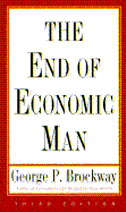
A Review: The End of Economic Man


The End of Economic Man
George P. Brockway

Reading this title was particularly appealing from a non-economist's perspective. Namely because the subject can be such a scrutinous, nebulous, heartless topic which endlessly appears to concern itself with the balancing of paretas, game theoreticals, vector units, graphs of continuous varieties and complex looking formulas for break even, profit and loss, lag and or productivity cycles, et al. Brockway entices interesting discussions on his pet topics, he is fairly obstinately opposed to FRB interest rate increases and has a left of centre perspective on squeamish topics such as true measures of productivity, and the disproportions inherent in the bottom 20% of labour consumption and production. They call him humanist, but I am not sure the skeleton he examines is completely human. There is something of a chimera in the shadow of economic man's ends. Certainly he writes more about man's purpose than his denouement.

But firstly, economic man is defined as a hypothetical being, free from altruistic sentiments or motives and selfishly pursuing wealth and its enjoyment. That such a man exists in hypothesis form is logically correct. That many outrageously wealthy men (and women, man appears as an assumption, something which economic measures are always satisfying with composite hypotheticals) certainly appear by all accounts to enjoy and pursue wealth with great singularity is fairly obvious. But on the basis of actual life, real situations, even those possessed of an understanding or interest in Euclidean space dimensions, it is highly improbable, and perhaps almost impossible, that any sentient being actually is completely bereft of any or all altruistic elements. Yes, Gates has his philanthropic interests, as did Carnegie. Soros, while reviled in countries like Malaysia seems to redistribute large portions of his wealth through educational training in Eastern Europe. Even Ted Turner has made significant divestments of his wealth. Brockway seeks to burst an illusion on the topic of economic man. Such an economic man only exists in the perceptions of principles, be they economic or not, associated with consequences and judgements made by individuals or communities of individuals in the realm of purchase and sale of commodities and or services (which are a more highly categorized variety of commodities).

The psychology of the study of such economics is Brockway's first target. He digs around in Adam Smith and Maynard Keynes, as each appears to do, he latches on to dead hands and nuggets of perceived wisdom. Whereas many disciplines have managed to move on philosophically from the Age of Mercantilism, it is an easy assessment to make that many in the field of economics guard more closely the tombs and graves of outdated theories in a quest for purity of reason that in many contemporary fields, from a humanistic perspective, economics as a science might appear outrageously attached to a bygone era and blissful aridity of bean-counting and its associated derivatives. But the consequences and judgements remain based in corporate dynamism, which appears to favour only recently issues such as Sarbanes-Oxley, accountability principles that attempt even to qualify or quantify intellectual properties inherent in staff allotments and intangibilities, Black-Scholes options pricing, and levels of financial transparency probably never imagined in Smith's often misattributed, entirely dead, invisible hand of economy.

Economic man is further defined as possessing inherent aspects of greed, a human condition, related to productive or consumptive capacities, and even Maslow would assume in the hierarchy of needs that greed plays a role in establishing the psychological priorities of man. Greed cannot be excised from an enlightened self interest, but it can be rationalized, often to a greater extent and net benefit to the individual or corporation than any degree of enlightened self interest might hope to reasonably attain. In all his discussion on the topic, Brockway hinges on three fairly solid antimonies of greed, and its relation to the work of economists. He beats the horse with these:

1. Maximizing profit and utility cannot be enacted simultaneously. Where one rises, the other falls.

2. In partial analysis, universality of greed and its converse, philanthropy, are undeniably equal in scope. However, some argue greed possesses greater limitations of net benefit.

3. Foolish greed is unpredictable, rational greed absurd.

Only perhaps in the last ten years of its conception has the world of economics been called to provide such new formulaic assumptions-based modeling. A new age skeletal anatomy of that clay-like claw is in the workings, mostly out of the demands of stock holders and dividend-desirous financiers who rightly credit the French for coming up with ideas like laissez faire anyway. Brockway jibes Smith for never providing any economic evidence of human interest in the moral behaviours of economic man. A fair complaint, but an impossible task to fulfill. Individual priorities, whether humanist or the result of base greed, in broadly defined pedestrian versus corporate societies can neither be ordered communitarily nor even deduced in a complete ranking of all their possible variations. Such idealisms may be enlightened, as Brockway's perspective, but offer little to the computational economist working exclusively within macro, micro, welfare, or market economics within base mathematicals, metrics, measures, and graphing out of real, real positive or even real negative lemmas. Such demands would be akin to asking the banana to devour the chimpanzee. However, it does appear to at least be wiggling around in contemporary perspectives on the topic of a revisionary perspective on economics.

So as Brockway leads into the topic of mathematics, economists seem to revel in the impartiality of measuring statistical sets of data according to formulas and equations to map out potentials at time specified event horizons and factorials. A self-enclosed, or open, dynamic, or static arrangement of events, inputs, outputs, and possible permutations based on statistical manipulations. Economic man quotes a defense of his retreat into the safety of the mathematical forest with, " our science must be mathematical, simply because it deals with quantities. Wherever the things treated are capable of being greater or less, there the laws and relations must be mathematical in nature." (William Stanley Jevons, 1871) Brockway indicates with ample historical evidence that the ways and means of economists and economic theory have followed the path of Newton and Max Plank because its adherents wish to stumble upon grand universalist type theories, whereas the topics of their study, namely money, goods, and services exist in the realm of human values rather than pure logic, physics, or mathematical esoteria. The relationship is subversive according to Brockway. Mathematical universes do not impact upon human values as do the results of econometrical formulas and decisions based upon their results. His best example is the inverse and reciprocal relationships in formulaic equations versus the unilinears of economy. Calendar or historic time dominate economics and are irreversible in reality of consequences and judgements in ways which pure mathematics or physics has never intended. He hints a linear destination in economics of illogical obtusiveness which is lacking a crucial element: the human factor.

His description of the value and purpose of money is enlightened and I have never before seen it so well explained. Money never has an actual fixed value theoretically it floats interalia between goods, commodities, and services and exists merely as a tool to interpret the values as accorded by buyers and sellers as a measuring device rather than holding its own discrete value. It is an agreed upon standard measure, and as markets prove, inter-trades, futures, and hedges place diverse values not on money itself but upon its imminent quality of liquidity, rather, the speed at which it can be converted from one measurable use to another. Its value is accorded in time vectors and future value is always of higher uncertainty, with added risk, while its immediate liquidity always makes a dollar today absolutely more valuable than any day in the future. Brockway illustrates the measurement of the purchasing power of money through the tabulation of consumer market price indicies and baskets of commodities, stocks, bonds, options, or currencies. But in measurement, only a snapshot can be taken while the continuous rise and fall of values is a consistent and interesting covergence with the physical impossibility of locating the exact positions of for example, electrons rotating around a nucleus. One may measure their speed or rate in the same manner as can be found in increases or declines in monetary values, but their exact location is never certain but hypothetically assumed as are currency variations. So many aggregate determiners influence money valuations to be nearly infinite, and quite influenced as in the allusive possibility that a butterfly's wings flapping in the Amazon could implicate the strength of a hurricane in the Carribean. But primarily consumer demands, and for example, mortgage rates on housing loans can implicate shifts in perceived purchasing powers. Supply is also an issue. For example, there are no standard or useful measures of the total amount of money in circulation, especially US dollars. Broad framework categories exist to segregate money into different flows of liquidity but they are vast numbers and amounts, often flowing continuously and almost seamlessly from one flow rate to another. Money is the sea. And everything bought and sold in the world is as flotsam and jetsam upon it.

The most familiar "law" of economics is probably supply and demand and their effects on prices. Small supply as in oil (or its refinement) then high demand raises prices and vice versa. However the dictates of market alone do not set real prices. Moral sentiments implicate fixed prices on many commodities versus what are considered natural price allocations. Economics often only fiddles with ideal pricing strategies which rarely come into effect or practice as substitution or monopolistic factors can implicate markets. It is often the same argument that US policy-makers support in their efforts to influence the trading patterns of their allies and partners, either through trade negotiations or treaties and pacts. But often in reality, the scene or stage setting for ideal pricing and free trade is never truly worked out and overwhelmingly appears to work in the interests of the US at times. The cost of maintaining free market economics may often exceed the perceived benefits. But overall Brockway insists that economic goods are human goods and price setters and takers are human beings, operating within the boundaries of responsibility and freedom.

The implications of economics on the scale and divisions of labour impact lightly in Brockway's interpretation of the economics of labour. He credits wage scales as human creations and that the highest allotments are afforded to speculators while a large proportion of mankind exist on only the most meager wages. Consumption and production are described as locked into set with one another and often reflects inequities in scale of consumption in one wage group versus another. The cost of labour alone has been the singular most important factor in the redistribution of manufacturing outputs and capital reallocations globally and continues to spiral in the increase since Brockway published this book in 1995. He realizes that enormous capital gains could be realized if the under or unemployed were considered of investment grade value to corporate organisations. The actual cost to convert such non-consumers would be lower than their expected contributions to consumption and production cycles.

In productivity Brockway bemoans the tools of measurement and the dearth of models which employ the maximization of consumption and production among the members of the bottom 20% of working populations, in some cases, only consuming 4.2% of their GNP. Few economists would contemplate tackling this issue and Brockway should be commended for even thinking of delivering such wonderful truffles. Then in the staving of inflationary pricing and loss of perceived real wages and savings, Brockway bemoans interest rate hikes courtesy of fellows like (recently former) Chairman Allan Greenspan's Federal Reserve Board hikes. In derailing inflationary control measures, Brockway would have the world's largest monetary unit, the world's largest net debtor, and largest consumer of capital goods (thanks to Leontieff's Principle) careening through international balances of payments without a brakeman. If anything, an idea? Yikes! As far as thoughful ideas, Brockway is full of them, and implicates that interest rate adjustments are unwelcome additions to what already should be free market economic profits and losses. As the last decade has taken a run on 24 hour money trading and markets which are only more and more linked technologically, such free markets could look like boom and bust gold rush towns from meridian to meridian and equator to equator. Just not sure if any of the lemmings are ready for an economic world without a guy like Greenspan. Oh well, the train may soon have to make do with a guy on the swizel stick named Bernanke. Hope he knows when to and when not to pull, how far, and how long.

Brockway delivers a wealth of knowledge and interesting questions to the occasional student of economics. But thank God he is not FRB Chairman. Economic man gets to deal a little longer? Whenever he passes, at least Brockway paints his face with humanism before the party is over.

A Review: The Portuguese Empire, 1415-1808


A delicious history of the little understood Portuguese expansionism which is often eclipsed throughout history by its descendant empire builders, namely the Spanish, the French, and the British. But it sometimes appears their legacy of pioneering explorations, voyages and trade routes appear lost in the visicitudes of time and are largely unremarked upon as globalized progenitors of the world's first international trades, wholesale commodities, migrations, transfer of cultural or linguistic legacy and blueprint for semi-developed empire to begin with.

It serves a contemporary student of global business well to delve into such historical accounts as much of the challenges or barriers to entry in many foreign markets, beyond technologies and territorial barriers, remain the same. Portuguese enterprise was largely surmounted by localized re-directions and the multiplication of foreign buyers and sellers. But at one time, the trading empire of Portugal literally ruled the world's trade routes. Russell-Wood's account was supported by The Portuguese National Commission for the Commemoration of Portuguese Discoveries, and listed in the short work, "Peoples and Empires: A Short History of European Migration, Exploration, and Conquest, from Greece To the Present" by Anthony Pagden as the best source on Portuguese Empire.

Russell-Wood is a reknowned and respected historian, his notes and chronologies run the last fifty-eight pages. Books which leave every footprint in the sand as he has done are much to be loved. He tells a story from sourced first-hand accounts, leaves little to conjecture or speculation, and reveals what history can tell simply as to the good and ill of empire itself on its own merits and flaws.

In addition all of the included plates are well done copies of original diagrams, maps, and illustrations taken from first-hand manuscripts and accounts which help display the width and breadth and depth of knowledge to which the Portuguese chronicled their exploits either in the realms of mapping and trade routes, technologies for milling of crops, proofs of impact locally as far away as Japan, the description of various native plants and crops, first descriptions and encounters with zoological discoveries, proven influences even in Chinese artistic and African musical arts upon Portuguese colonial vestiges remaining in the New World, and even ample evidence of Mughal and Indian artistry influenced by Christian elements courtesy of the Portuguese.

However this being said, I do remember a man from Mozambique saying that he hated the Portuguese intensely. Russell-Wood has respect for his supporters, he does not pillory the past, he does not apologize to a contemporary audience for the sins of empire. But he reveals how significantly the same forces which instilled a sense of greed and wantoness at the same time, albeit over hundreds of years, helped breed the intellectual and humanist debates and status quo shifts to the present which continues to globally wrestle with a taste for compassion and redresses among the empire builders of the current day. The issues remain the same. Successful enterprises continue to profit from the exploitations of migrant labour. As it was it continues to be a huge successful and profitable enterprise, especially in Asia and especially its more illicit, ILO minimum standards excluded forms.

His first chapter reveals the long lists of Portuguese explorers from the early days of the late 1300s with Dom Fernando de Castro and his voyage to The Canaries, Infante Dom Pedro traipsing throughout Europe, the first sighting of The Azores under the scopes of Diogo de Silves to the first rounding of the Cape Bojador by an endeavouring Gil Eanes in 1434. 1441 saw the first cargoes of human slaves from Mauretanian coasts landed at Lagos, Portugal from which a horrendous trade ensued and upon which all empires profited. In the early 1440s first sugar cane cultivations took place in Madeira and by the 1450s Guinea and Sierra Leone were taken. A series of islands, conspicuous in their lack of necessity and esoteric importance to the present, were essential and vital to the trans-shipping of goods and were rounded and claimed up into the early 1500s such as Cape Verde, Sao Tome, Principe, Greenland, etc.

It is even interesting to note that Columbus of 1492 fame offered to sail for the Portuguese in 1483/4 but his services were rejected by Dom Joao II. By the late 1400s Vasco de Gama was on his way to Goa, the Corte Real brothers were exploring and nosing about in Eastern Canada and forts were being christened from Pernambuco and Porto Seguro in South America to Gale in Ceylon by the early 1500s. In 1513 the Portuguese arrived in China, Ethiopia, Santo Agostinho and Rio de la Palta. They were the international octopus of their nearly two hundred years head- start on the rest of the Europeans.

The Portuguese marvels of technology at the time of expansions included the vast and sturdy designs and flotillas of wift trading caravels, stout carracks, sturdy camelled and muled caravans, lean canoes, and wooden ox-carts with which commodities could be warily transported around and across the world. Loss rates reaching 25% on every voyage or journey meant one out of four of every vessels sailing would be lost as well as one out of every four explorers. Their lives were fraught with risk and danger, eventually the accounts of the time even mention the necessities of the business. Success or death. Such realities played heavily upon the negotiation and trading skills of the Portuguese. Where one expects many notations on violent take-overs and wars, one more often discovers localized highly specified agreements with tribal leaders, local traders, and protection by kingly fiats and treaties the world over. One might assume the Portuguese were often like a plague upon the earth, and in many ways they were. But in other ways they appear merely as opportunistic pescas (fish).

Migrants and settlers were often the lowest order of society, cut-throats and bandits, often taking local wives out of the lack of Portuguese women to marry. The interests of the Crown and Church were often complimentary, highly structured, but easily undermined through corrupt and fiendish officials and monastics. Much is noted of the greed of many in these accounts, written of by Portuguese themselves, through the institution of forced slave migrations and the enslavement of localized populations. Many commodities were thus born on the backs of the powerless, nameless, landless slaves. In the end Russell-Wood notes the slower pattern of infection and death through Portuguese-born diseases when compared to the rates of infection brought through Spanish presences globally. It is of little comfort, but was slower and lesser to a degree due to a lower concentration of carriers and local populations among the Portuguese. Better to die slower more singularly than quick in such a case? I am sure it is not intended however as it comes across. it is rather grisly.

One chapter deals wholely upon the nearly limitless lists of trade products both to and from the New World and the Old World through Lisbon, Salvador, Rio de Janeiro, Luanda, Goa, Malacca, Macao, or Nagasaki, all pivotal hubs of truly global trading routes. Much profit was made from the early 1400s onward in products such as malaguetta pepper, known as "the grains of paradise", tusks, skins, export crops, rye and grains, velvets, silks, apparels, woolens, cloths, textiles, brassware, bronzes, copper, leafwares, glass, bowls, silver, mercury, tin, lead, arms, guns, munitions, faience, tapestries, cinnabar, clocks, and furnishings, fish, corals, carpets, dates, grapes, alambeis, wax, indigo, tuna, sardines, mullet, sugar, wines, malvasia, resins, "dragon's blood" (sangue de dragao), woad, salt, maize, orchil, as well as species of woods such as brazilwood, the aloes (garu and calambac), camphor gum benzoins, saffrons, sharkskins, gold, mother of pearl, lacquers, medicinal musks, rhizome galangals, sorrel rhubarbs, coffee, honey, pork, cocoa, tapioca, cashews, sesame, oxen, wolves, bears, and puma skins, the list is endless.

The Portuguese brought and sold all of these products and many more, as well as provisoning the first traded commodities of cork, soap, olive oil, fruits, quince, marmalades, sumacs, cloves, maces, gingers, cinnamons, nutmegs, sugars, calicos, oranges and salt on a global scale, fairly significantly introducing truly international regualr, speculative trade in base commodities to nearly the entire world starting nearly half a millennia ago.

The fourth chapter most clearly demonstrates the hard to determine extent of transmission of styles, mores, and ideas through Portuguese trade in Africa, India, and Brazil starting first with urban imprints. From Mozambique to Timor, in Cochin and the Mattanchery, radical transformations often took place, the results were often more than the addition of large roving bands of families named Pereira to local populations. Old Goa is an example of a Rennaisance City still glimpsed through its ruins and monuments. Places like Upper Macao still display such influence. Gilded works and interior designs of several global period churches, libraries and public buildings display the construction methods and rare woods of the "Golden Age" of Brazil.

There was also much blending of Portuguese and non-European forms, collectively called Indo-Portuguese Art. Russell-Wood notes it is difficult to fully address all the influences, but concludes that through half a millennia of interactions with other peoples, Portuguese policies, " ranged between respect and tolerance for local ways of life to extreme intolerance and draconian acts of suppression." Such interactions were often denoted under official sanction and unofficial relaxation or tightening of regulations and royal edicts, papal bulls or the like. Portuguese in-bound influences included adjustment of dietary intakes, an expansion of palate, changes in sartorial fashions, the smoking of tobaccos and perhaps some added swagger. It appears an unjust imbalance nonetheless.

The significance of the spread of the Portuguese language is in its current global European language usage third (186 million) only to English (487 million) and Spanish (401 million). Formal education instituted following Jesuits, Dominicans, Augustinians and Carmalites from India to the Americas helped transfer ideas often carried from Europe to noble or samurai classes in Portugal, the Azores, Angloa, Mozambique, India, Thailand, Macao, China, Japan, and Brazil numbering 77 institutions of higher learning in total by 1759. These represented the pioneers of the spread of Christianity around the world as Europe's first official evangelizers. The Portuguese are noted to have been most engaged with Europe intellectually during the 16th century Age of Humanism and the 18th century Age of Enlightenment however it is difficult to trace a transfer of these concepts to colonial locations. Portuguese impact intellectually is most easily traced to Brazil, known as a hot-bed of Jacobinic ideas and admirers of Adam Smith, Locke, and Burke in their periods.

Finally, this book sums up Portuguese contributions as essential to all of the discoveries which took place following their voyages and the influence and extent of their knowledge of the world. Fernao de Magalhaes (Magellan), Francis Xavier, Jorge Alvares, Prester John, Martim Afonso de Sousa, Matteo Ricci, each with a story to tell makr the chronologies of history. Russell-Wood reveals these to be merely the peaks of Portuguese exploits and he helps define the vast valleys and trails of the legacies of many more unknown Portuguese who lived and died helping in some way to define the world as they knew it.

This book is a good credit to history and a good read for anyone who enjoys armchair travels. It is also a perspective of totality of influence and period which makes this read interesting. The narrative does not run linearly but cross-dimensionally. As in the The Portuguese Empire took up trade virtually with every region on earth over a period of several hundreds of years, it appears as a lasting element in the way large portions of the world continue to evolve. In effect, the borders of Portugal ill define its world affairs. As does history sometimes ill define events. A good digression to take before tackling Jared Diamond's current immensely popular treatises.

A Review: The Great Hill Stations of Asia

A good bit of background filler. Barbara Crossette sallies around southeast Asian hill stations moaning on and about the great social and cultural relevance of these places to dead imperialists and their modern local Asian economic equivalents. Who cares? There are still plenty of interesting facts.

There are not a great number of these hill stations that I have visited, just Nuwaralia in Sri Lanka and Ooty in Tamil Nadu, but I was astounded by the rates of growth of unleashed development along the roads of former jungles on the way from Mysore alone, saddened equally that the grand result of development in India resulted in such a devastating loss of flora and fauna. Even the rock pickers could use a frond to sit under. Crossette nearly describes my own bus ride to Ooty except for how my British nurse nearly drowned in the rainstorm as the bus roof patches gave way. Trapped wet and shivering in such conditions in a Tonka bus sounds like heaven compared to what days in a soggy wet hanging bundle would be like.

Bandipur Park appeared as a real nightmare, nothing from the main roads but the muddy asses of elephants running out of the way in the distances of trampled undergrowth and great fire scourged sections just trying to get the hell away from the masses of gawkers and hawkers. I doubt any tigers remain there under such circumstances. I thought Sri Lanka in the mountains was a fairly denuded landscape but considering the financial options available to so few and required by so many, it is hard to blame the locals for the issues of preservation which will haunt these hills forever. However I would return to Ooty, it still has a breath of quiet and peaceful languid paces. You can walk around without fearing being run down by beggars or thieves. Same for Nuwaralia. I stayed initially in the new wing of the former Governor General's residence, but I recommend anyone to stay closer to the kitchen, especially in off season. The new wing smells fully of ghosts and is mouldering away in the humid earth.

I was fully amazed at Peredinia Gardens and I concur with Crossette they are by far the most beautiful and majestic gardens I have ever seen. I guess I read the book to find out more about places I have been and others I might like to visit. Certainly Dalat figures on my future travel plans because of this book. I think if I returned to South India Ooty would be my direct destination.

Indirectly in India, it always the journey that seems to matter. Crossette captured some of that journey in her book.

A Review: Globalization and Fragmentation: International Relations in the Twentieth Century


Ian Clark has written a highly scholary account of international trade from the turn of the century (the previous turn) to the late 1990's. The good thing about a well researched and annotated account of global trade, from a historical perspective, is that it never really goes out of date. Perspectives change and comparative data or methods may increase. But this book contains a richness of information written in a lucid and understated style which some may call dry, especially if their preferred method of data collection is the internet, or television.

Some of the most interesting points Clark raises actually appear in the introduction. He defines the power vacuum in the withdrawal of British and European interests from China post WW One as being the point of entry for Japan's dominance in the Asian continent. However, Japanese influence was more easterly, more trading based than infrastructural during the period of European early imperialism in Asia; but his description is fascinating. As a result of the war and preparation for it, international trade at that time actually diminshed due to growth in national interests. As well, the polarization of Wilsonianism versus Communism invoked a compromise state of unionism which also impacted heavily upon the contemporary middle-class values of the day. They were heavily impacted upon by the needs and wishes of the lower-middle industrial classes on one hand, and the powerful corporations and national leadership interests remaining in power, and instituting where they could, international influence over national values globally, or at that time, merely the European and American worlds.

A lot of what Clark has to say about the 1880s to 1920s period in relationship to Germany and Japan would appear quite relevant to Chinese potential for growth today. In both periods, a new entrant to trade is surrounded by competitors and supplier markets; resource allocations and pricing strategies of varying accountability, and networks of national interests and corporate structures which do not always act in unisons or concordances. The interwar periods are described fairly succinctly, but Clark under-emphasizes the immense phase change and shift between a British-dominated international captial market and the American one. He does not fully come to terms with the implications for which America had profited through the institution of gold standard and Bretton Woods Agreements, nor the immense losses of British hegemony at that time. Clark interestingly analyzes the post war and Cold War Period, with several relevant hypotheses, one of which, the American in particular, distinction between internationalism versus globalism, as it is relevant to America's contemporary inability to maintain dominance in a globalized enviroment of free capital movements from which it originated growth but from which as it grows reduces American control.

He also makes interesting his title of globalisation and fragmentation, which helps explain how difficult it is to actually reconcile a true lack of globalisation among member nations in an international economic web of increasing delicacy, for example, the fact that ILO was instituted to protect worker rights, but in many participant nations, particularly in SE Asia, the real current schemes exclude non-visa issued transnational labour from even ILO minimum standards of treatment. In the end, Clark posits globalisation has worked best in the areas of FDI and capital movement, but on internationalizing the national economies of individual nations, he appears to discredit such ideas and claims that they are indeed the greater influence of fragmentationist events.

It took a long time to get through this book, and as it is routinely peppered by reference notes, it would not be the first book I would recommend on global economics. But it would be among the best I have read in terms of breadth and scope and greater economy of delivery.